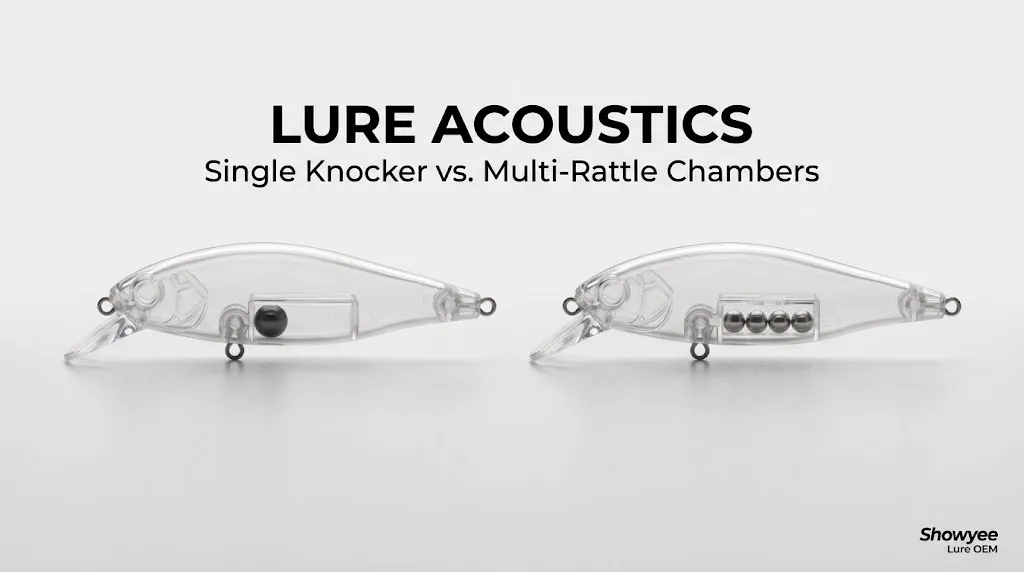
Lure Acoustics Engineering: Custom Single Knocker vs. Multi-Rattle Chambers
Core Introduction: Why Your Lure Sounds Muffled Underwater — or Worse, Dead Silent
Many brands think dropping a few generic steel BBs into a hollow mold cavity equals “acoustic engineering.” It doesn’t. Sound frequency, internal ball mass, chamber wall thickness, and weld tolerances are what separate a tournament-winning strike trigger from a fish-spooking noise machine.
This engineering teardown breaks down the acoustic physics inside hard baits — and demonstrates how Showyee Lure engineers custom resonance chambers, tungsten single knocker systems, and silent ghost configurations for brands that refuse to compromise on build quality.
Why Subsurface Sound Frequency Trumps Pure Volume
Every experienced angler knows that when visibility drops in stained rivers or at 20-foot depths, predatory gamefish rely on their lateral line (neuromast cells) and inner ears long before they visually lock onto a bait.
Sound travels approximately 4.3 times faster in water (≈ 1,480 m/s) than in air. But louder is not always better. A high-decibel tinny rattle in clear, pressured reservoirs will spook tournament bass, while a soft high-frequency buzz gets entirely absorbed in heavy grass flats.
At Showyee Lure, we engineer internal acoustic chambers around target frequencies, ball densities, and resonant wall thicknesses rather than random cavity spacing. Here is the acoustic science behind one-knocker thumpers, high-pitch rattles, and silent ghost lures.
1. Fish Auditory Reception & Custom Lure Acoustic Frequencies
Predatory gamefish (largemouth bass, pike, walleye, and sea bass) perceive underwater vibrations across two distinct physical frequency bands:
Infrasound & Displacement (10 Hz – 150 Hz)
Detected via the lateral line. Generated primarily by lure body wobble, tail kick, and low-frequency "thumping" internal knockers.
Sound Pressure Waves (100 Hz – 1,000+ Hz)
Detected via the fish's otolith (inner ear). Emitted by internal rattling ball impacts against ABS internal ribbing.
Frequency-to-Source Reference
| Sound Source | Frequency Range | Primary Fish Detection Mechanism |
|---|---|---|
| Lure Body Displacement | 10 – 100 Hz | Lateral Line (Direct Water Displacement) |
| Tungsten Single Knocker | 150 – 400 Hz | Deep Thud (Penetrates Silt & Long Distances) |
| Stainless Steel Multi-BB | 1.5 – 3.0 kHz | Otolith / Inner Ear (Baitfish Schooling Chatter) |
| Glass / Ceramic Micro-Beads | 4.0 – 6.0 kHz | Otolith (High-Frequency Shrill for Dense Cover) |
2. Single Knocker vs. Multi-Rattle: OEM Acoustic Chamber Engineering
The acoustic profile of a hard bait is governed by three physical variables: Ball Mass ($m$), Impact Velocity ($v$), and Chamber Wall Hardness ($H$).
A. Single Knocker Chambers in Deep Crankbaits & Topwaters (150–350 Hz)
- Ball Configuration: Single oversized heavy sphere — dense Tungsten or solid brass (∅ 7.0mm – 9.5mm).
- Chamber Geometry: Transverse elongated track spanning the lure’s lateral axis.
- The Mechanical Goal: Deliver maximum kinetic energy transfer per stroke. When the bait rolls on its side during retrieval, the heavy ball strikes the internal ABS wall with a violent, low-frequency "THUD".
- Target Scenario: Deep crankbaits (15–25 ft), windy mud lines, and nocturnal topwater walking baits where low-frequency sound waves travel significantly farther without scattering.
B. Multi-Ball Resonance Chambers in Lipless Cranks & Jerkbaits (2.0–5.5 kHz)
- Ball Configuration: 4 to 8 miniature precision stainless steel (440C) or tempered glass micro-spheres (∅ 2.5mm – 3.5mm).
- Chamber Geometry: Segmented micro-cavities along the belly or dorsal spine.
- The Mechanical Goal: Create rapid, multi-angle chaotic collisions simulating the frantic clicking sounds of a baitfish pod or fleeing crawfish.
- Target Scenario: Lipless vibration baits ripping through submerged hydrilla and fast-twitching jerkbaits targeting schooling pelagic predators.
3. Structural Tolerance & Ultrasonic Welding Control
An acoustic chamber is only as effective as the integrity of the surrounding mold casing:
Wall Density & Resonance
If the ABS injection wall is too thin (< 1.0mm), the chamber flexes, absorbing sound energy rather than radiating it outward. Showyee engineers localized acoustic strike ribs with reinforced 1.4mm – 1.8mm impact plates.
Zero Seepage Ultrasonic Bonding
A single droplet of water inside the chamber causes surface tension damping, neutralizing ball movement and rendering the bait completely dead-silent. Every sealed Showyee body undergoes 100% pneumatic pressure testing to guarantee an airtight acoustic cavity.
Silent "Ghost" Chambers
For ultra-clear, high-pressure tournament waters, we precision-lock internal tungsten ballast blocks with dual-point positioning posts, eliminating all internal rattle for a pure hydrodynamic presence.
Acoustic Performance Matrix by Sourcing Category
| Acoustic Profile | Ball Material & Size | Dominant Frequency Range | Target Water Condition & Action |
|---|---|---|---|
| Deep Single Knocker | Heavy Tungsten (∅ 8.0mm+) | 150 – 350 Hz (Heavy Thud) | Deep diving (15ft+), muddy rivers, low visibility |
| Multi-Steel Chatter | 4–6x Stainless 440C (∅ 3.0mm) | 1.8 – 3.2 kHz (Crisp Click) | Stained open water, schooling baitfish, rip-jerk action |
| Micro-Glass Shrill | High-Hardness Glass Beads | 4.0 – 6.0 kHz (High Sizzle) | Thick aquatic grass beds, cold water reaction bites |
| 100% Silent Ghost | Post-Locked Tungsten Ballast | 0 Hz (Pure Vibration Only) | Gin-clear lakes, pressured tournament fisheries |
Frequently Asked Questions (FAQ)
Q1: Can Showyee customize rattle frequencies in existing lure blank models?
A: Yes. We can modify internal ball alloys (exchanging standard steel bearings for dense tungsten or high-pitch tempered glass) and reposition chamber stops to customize acoustic signatures without requiring brand-new injection tooling.
Q2: Why do fishing lure knockers get stuck during casting?
A: Poor mold draft angles and loose tooling tolerances cause heavy balls to wedge into narrow chamber corners during high-velocity casting acceleration. Showyee designs radiused internal chamfers and mirror-polished tracks to ensure instant ball release on water entry.
Q3: How do you verify sound frequency consistency across mass production runs?
A: We perform hydrophone tank recordings on pre-production batches (T1/T2), analyzing frequency spectrum graphs to verify that every production run matches the approved master acoustic signature.
Build Your Brand’s Signature Sound Profile with Showyee Lure
Differentiate your hard baits with engineered acoustic chambers built for real-world predatory response. Whether you need a deep-thumping tournament knocker or a perfectly balanced silent jerkbait, our engineering team is ready to assist.