Why Hard Fishing Lures Leak & How 100% Air-Pressure Testing Prevents It | Showyee Lure OEM
Introduction
For any hard lure brand, there is no defect more devastating than a leaky body. A hard bait that absorbs water loses its calculated buoyancy. A suspending jerkbait turns into a fast-sinking rock; a topwater walking bait loses its rhythmic action; and internal metal weight transfer systems rust and seize up. Worse yet, when anglers experience a leaking lure on the water, they don't blame the factory—they lose trust in your brand forever.
At Showyee Lure, we treat waterproofing not as an optional quality check, but as the foundational baseline of lure manufacturing. In this guide, we break down why hard baits leak in production and the engineering solutions we use to eliminate water intrusion completely.
The 3 Root Causes of Water Intrusion in Hard Baits
Understanding why lures leak requires a close look at the injection molding and assembly process. Water usually enters through three primary failure points:
1. Inconsistent Ultrasonic Welding
Most hard ABS lures consist of two half-shells welded together using ultrasonic energy. If the welding horn alignment, frequency, or pressure fluctuates during mass production, microscopic voids can form along the body seamline. While invisible to the naked eye, water forces its way into these micro-gaps under hydrostatic pressure.
2. Stress Fractures Around Towing & Hook Eyelets
Lures endure constant physical strain—from violent strikes by predatory fish to hard casts against structure. If the internal anchor points around the line tie or hook hangers are under-engineered, stress fractures can develop where the metal eyelet pierces the plastic shell, creating direct pathways for water.
3. Thermal Expansion Gaps
When a lure sits in a hot tackle box on a boat deck and is suddenly cast into cold water, the air inside the hollow body rapidly contracts. This creates a vacuum effect inside the chamber. If the perimeter seal has even the slightest weakness, the body actively sucks water inside.
How Showyee Lure Eliminates Leaks in Mass Production
To guarantee that every single lure leaving our facility remains 100% airtight, we implement a multi-layered manufacturing and quality assurance system.
Step 1: Precision Mold Sealing & Internal Structural Ribbing
Preventing leaks starts at the mold design stage. Our engineering team incorporates proprietary inter-locking tongue-and-groove joints along the mating seams of our ABS halves. Additionally, internal structural ribs reinforce the body around all internal weight chambers and wire channels, preventing the shell from flexing open under high pressure.
Step 2: Integrated Wire-Through Construction for Big-Game Baits
For pelagic and heavy-duty lures, traditional screw-eye configurations are prone to breaking and leaking under extreme fighting drag. We utilize full stainless steel wire-through harnesses. The continuous internal wire transfers strain across the entire lure body rather than pulling on isolated plastic points, preventing stress fractures around the eyelets.
Step 3: 100% Air-Pressure Leak Testing (No Random Sampling)
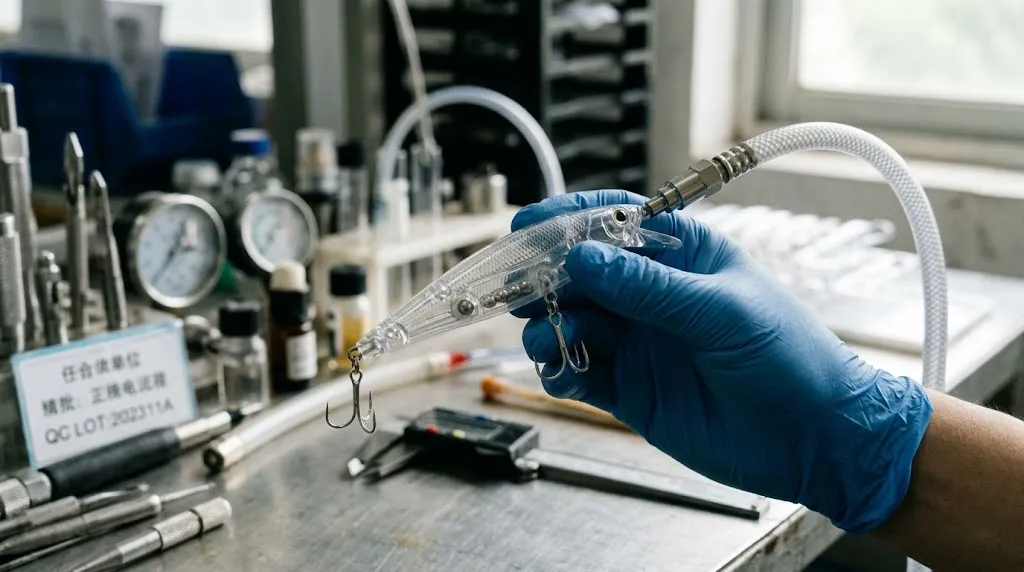
Many standard OEM factories rely on basic visual inspection or random batch sampling (e.g., testing only 5 out of 100 lures). At Showyee Lure, we conduct 100% air-pressure leak testing on every hollow hard bait body before painting.
How Our Air Pressure Test Works:
- The assembled, raw ABS lure body is submerged in a clear testing tank.
- Pressurized air is injected directly into the internal chamber through a sealed fixture.
- If a microscopic seam defect or fracture exists, a steady stream of air bubbles immediately escapes into the water.
- Any body showing bubble release is instantly rejected and discarded—ensuring zero defective shells ever reach the painting department.
Step 4: Post-Paint Seal Integrity Inspection
After applying custom multi-layer basecoats, holographic foils, and durable topcoats, lures are subjected to a final thermal-shock water submersion test. This verifies that clear coats haven't compromised eyelet sealing and that the finished lure withstands extreme temperature shifts without drawing moisture.
Quality Control Inspection Comparison
| Quality Standard | Standard OEM Supplier | Showyee Lure R&D Facility |
|---|---|---|
| Leak Test Coverage | 1% to 5% random sampling | 100% individual air-pressure testing on all hard baits |
| Seamline Integrity | Standard flat-edge ultrasonic welding | Tongue-and-groove interlocking seam engineering |
| Heavy-Duty Rigging | Basic glued eyelet screws | Full stainless steel wire-through internal harnesses |
| Defect Guarantee | High defect allowance rate | Zero-tolerance leak policy before painting and shipping |
Frequently Asked Questions (FAQ)
Q1: Why do you conduct air-pressure testing BEFORE painting instead of after?
A: Testing raw ABS bodies before painting allows us to detect structural seam defects at the source without paint layers temporarily "clogging" a micro-gap. Once an unpainted body passes 100% airtight testing, our multi-layer primers, custom paint, and tough clear coats add an additional protective barrier on top of a perfectly sealed shell.
Q2: Can your factory handle custom wire-through designs for saltwater or big-game lures?
A: Yes. We specialize in custom wire-through construction for heavy-duty saltwater lures, topwater poppers, and large swimbaits. Our engineers design custom stainless steel wire harnesses precisely molded into the ABS internal ribbing to handle drag pressures exceeding 50kg+ without structural leakage.
Q3: What is the defect rate allowance for Showyee Lure OEM shipments?
A: Because of our 100% air-pressure testing process, our functional leakage defect rate is virtually 0%. We back our manufacturing with strict Quality Acceptance Standards (AQL) to protect your brand reputation.
Partner with a Zero-Defect Lure Manufacturer
Don't let leaking lures compromise your hard-earned brand reputation. Partner with an OEM/ODM manufacturer that treats precision engineering and 100% quality testing as standard practice.