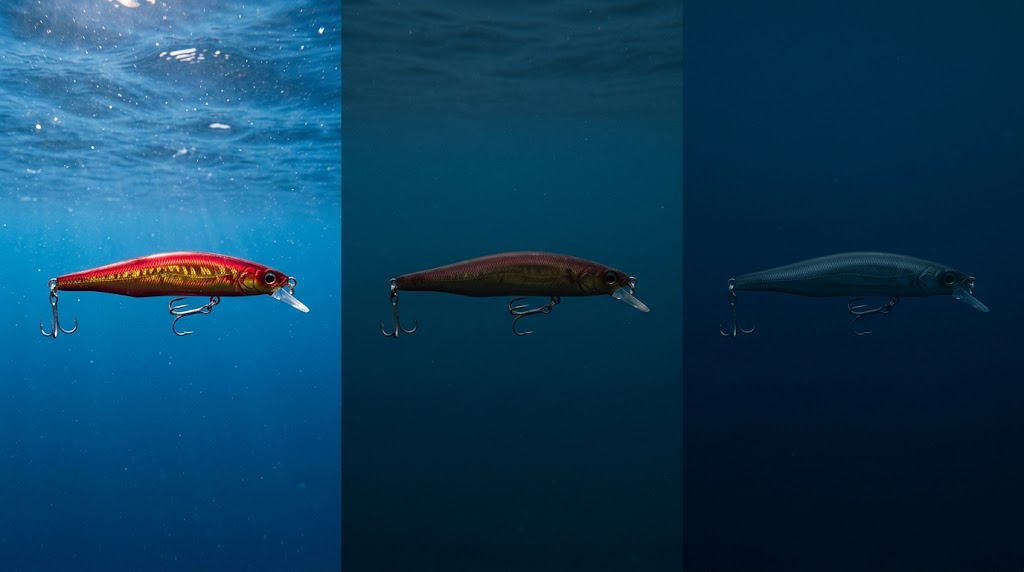
Underwater Optics & 2K Lure Coatings: Refractive Index Engineering
Custom lure painters and tackle brand owners know this frustration all too well: stunning under 5000K studio lights with fiery reds, brilliant golds, and deep gloss clear coat — yet cast it into 15-to-25-foot water, and it collapses into a flat, faded gray silhouette.
Predatory game fish don’t see the colors you see on a retail shelf. The underwater environment is a ruthless chromatic filter. OEM manufacturers must formulate base foils, pearlescent layers, and protective clear coats around water-column wavelength attenuation and optical refractive index (RI). Otherwise, your lure loses its visual trigger point the instant it submerges.
At Showyee Lure, we treat lure coatings as applied optical science. Here is the engineering reality of underwater light transmission — and how advanced 2K clear coat chemistry preserves refractive contrast at depth.
Wavelength Attenuation: The Physics of Underwater Color Loss
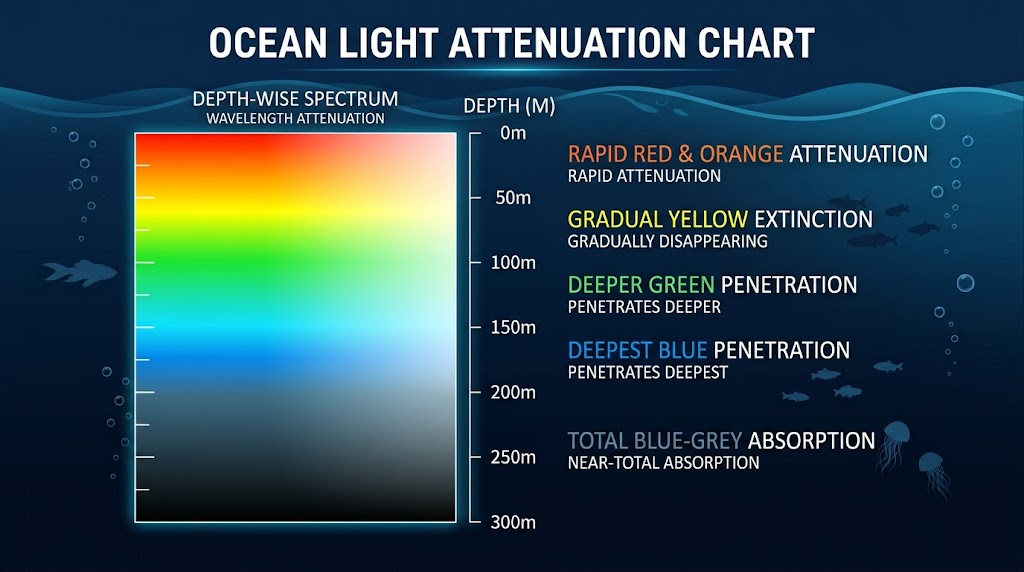
Water molecules and suspended particulates selectively absorb and scatter electromagnetic radiation by wavelength (λ):
OEM Color Design Engineering Implications
The “Red Overflow” Trap: Red gill accents or red throat markings turn pure black below 12 feet. Contrast must be engineered into the primer layer — not merely painted onto the topcoat. Otherwise, your target attack point vanishes.
Fluorescent Frequency Conversion: Standard pigments only reflect existing ambient wavelengths. Fluorescent and UV pigments absorb invisible high-energy UV (300–400 nm) — which penetrates far deeper than red light — and re-emit it as longer visible green/yellow-green wavelengths (520–560 nm). This is why engineered UV patterns act as glowing beacons in deep zones.
Refractive Index Mismatch: Why Cheap Clear Coats “Blind” Holographic Foil
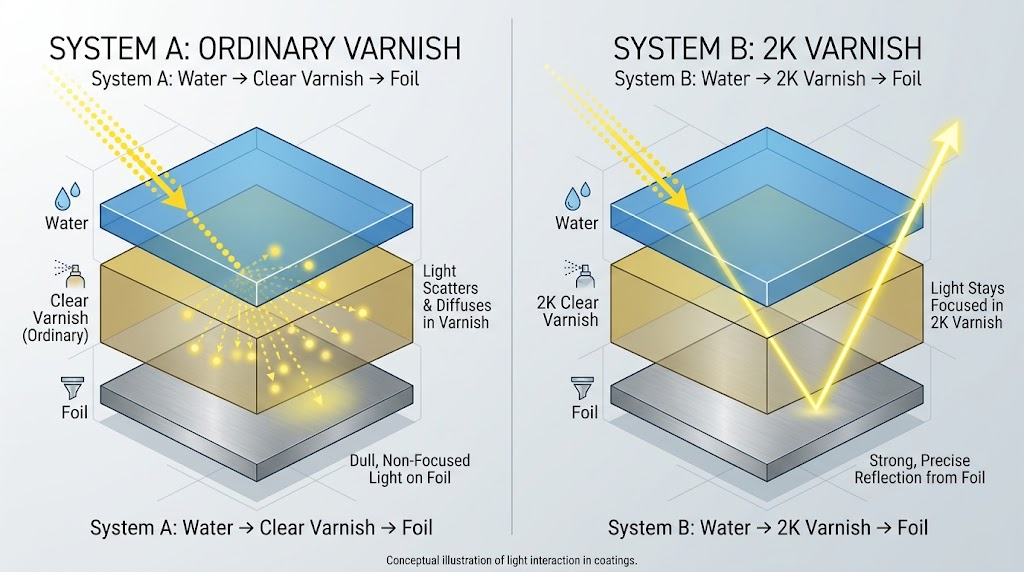
Light bends and reflects at interfaces between materials of differing optical densities, governed strictly by Snell’s Law:
Standard 1K Clear Coat (n=1.42) vs. High-Solids 2K (n=1.53)
When low-density 1K acrylic clear coat goes underwater, the refractive index gap between water (n=1.33) and the coating (n=1.42) is too narrow. Light scatters at microscopic surface imperfections, causing underlying holographic foil specular reflectance to drop by up to 42%.
Showyee-engineered ultra-high-density, cross-linked 2K aliphatic polyurethane coating (n ≈ 1.53) acts as a precision optical lens. Internal reflections remain tightly focused, amplifying micro-prismatic flashes even in ultra-low-light pelagic waters.
Surface Physics: Preventing Micro-Pinholes & Saltwater Hazing
Underwater optical clarity cannot exist without structural durability:
Cross-Hatch Adhesion & Zero Delamination: Cheap air-dry coats leave micro-porosities that absorb moisture during repeated casts, turning cloudy (milky hazing) and destroying optical depth. Showyee’s high-temperature baked 2K polyurethane reaches 3H–4H pencil hardness, forming a completely impervious barrier against hydrostatic pressure and predator strikes.
Anti-Yellowing UV Inhibitors: Integrated Hindered Amine Light Stabilizers (HALS) block photochemical polymer breakdown, maintaining crystalline clarity and active fluorescence over seasons of UV exposure.
| Engineering Metric | Standard 1K Dip-Coat | Showyee 2K Optical Polymer |
|---|---|---|
| Refractive Index (n) | 1.42 – 1.45 (Standard) | 1.51 – 1.54 (High-Clarity Optical Grade) |
| Underwater Flash Loss @ 15ft | 35% – 50% Reflection Loss | <8% Loss (Retains Specular Flash) |
| Hydrophobic Seal Quality | Porosity causes milky hazing | 100% Sealed Impervious Barrier |
| Pencil Hardness | Scratched by hooks (HB – 1H) | Bite & Scratch Resistant (3H – 4H) |
| UV Photostability | Prone to yellowing & embrittlement | HALS-stabilized (Active Fluorescence) |
Frequently Asked Questions (FAQ)
Summary: Don’t Let Your Lure Run Naked in Deep Water
Every serious angler knows the feeling: a lure that dominates the morning in shallow shallows suddenly goes dead when fished deep. It’s not that the fish stopped biting — it’s that the finish optical system collapsed.
A standard clear coat is akin to wrapping your lure in frosted plastic. Showyee’s 2K optical polymer system acts as a precision marine lens, ensuring lethal visual attraction at any depth.